
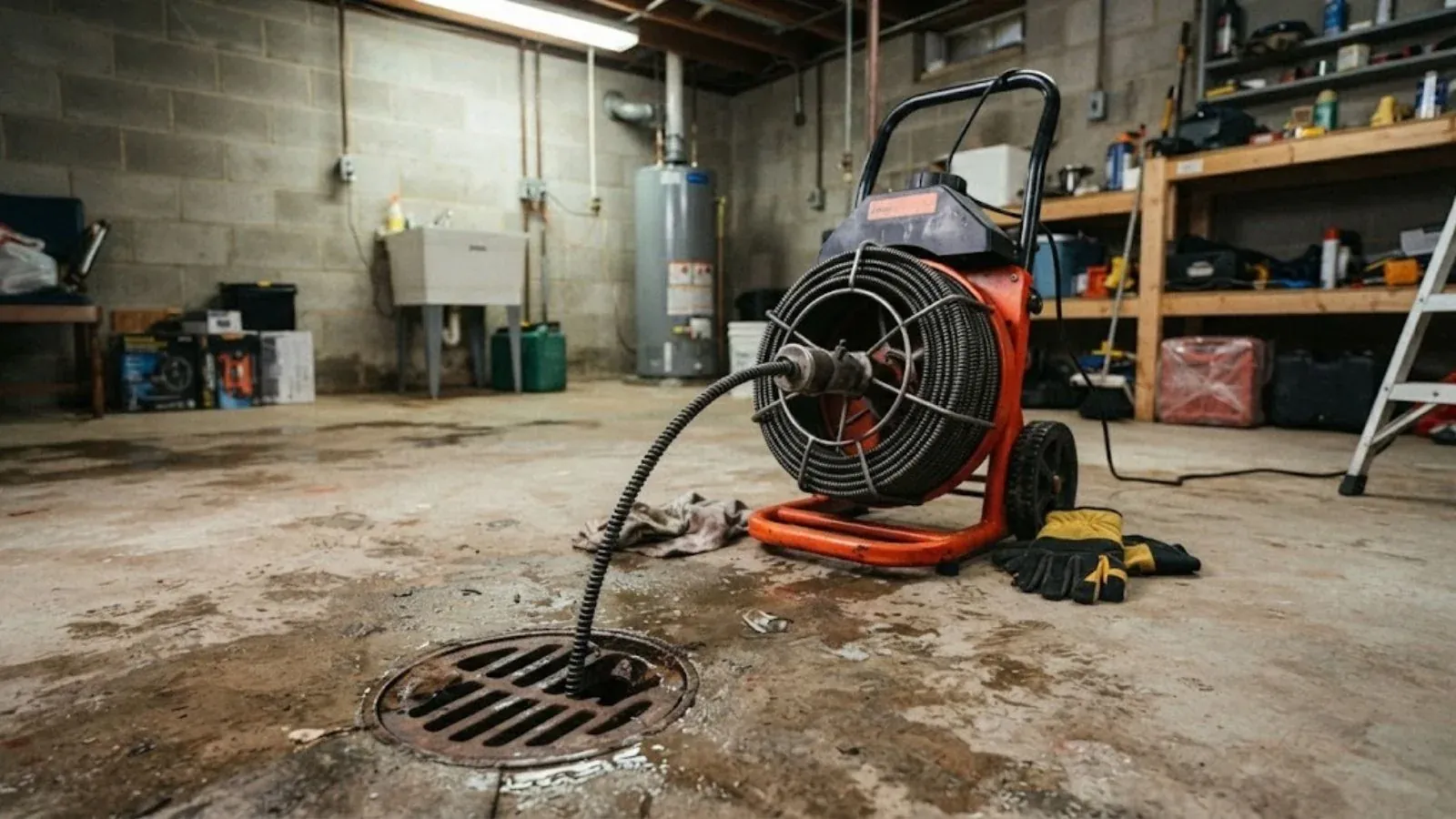
Pick the right snake for the job
Using the wrong tool is the most common reason a DIY clear fails or damages a fixture.
| Tool | Best for | Avoid using it on |
|---|---|---|
| Hand auger (drain snake) | Bathroom sinks, tub drains, shower drains | Toilets, since the cable can scratch porcelain |
| Closet auger (toilet auger) | Toilet clogs near the bowl | Sinks and tubs, since it is too short |
| Drum auger | Longer branch lines such as a kitchen line | Mainline, if you are unsure about the pipe |
| Power auger or machine | Large lines and tough clogs | Fixtures, unless you are trained |
A hand auger usually carries 15 to 25 feet of cable. That is plenty for a sink, but it will not reach a main line.
Before you start
A few minutes of preparation prevents most mistakes.
- Remove standing water if you can, using a cup or a small wet vacuum.
- Put on gloves and eye protection, since drain debris can splash.
- Lay towels and a bucket under the sink trap area.
- Do not pour chemical drain cleaner first. If it is already in the drain, treat the water as hazardous.
- Check the stopper or pop-up in a tub or sink and remove it if it lifts out.
- Have a flashlight and an old toothbrush for cleaning the cable.
Why Marana drains clog the way they do
The Town of Marana's hardness table shows groundwater at roughly 3 to 14 grains per gallon depending on the neighborhood. Picture Rocks and the Airline/Lambert system average about 12, while Hartman Vistas is near 5. Harder water leaves more mineral buildup in drains and fixtures, so homes in the harder areas may see slower drains over time.
The Town says hardness poses no health risk, though it leaves deposits on fixtures and dishes. In practice, that means cleaning strainers and aerators regularly and not relying on a snake alone if a drain keeps slowing. If you live in Picture Rocks, our Picture Rocks plumber page explains local service.
Most newer Marana homes are built on concrete slabs, so drain lines often run in or under the slab. That is one more reason to avoid forcing a cable through a stubborn clog. A damaged pipe under the slab is a much bigger repair than a clog.
Clearing a bathroom sink or tub
Bathroom clogs are usually hair and soap. They sit within a few feet of the opening, so a hand auger often works.
- 1
Remove the drain cover
Lift out the stopper or unscrew the strainer. Pull out any hair you can see by hand.
- 2
Feed the cable gently
Push the cable end into the drain and turn the handle clockwise as you advance it. Do not force it around bends.
- 3
Work the clog
When you feel resistance, crank in short motions and push forward a little. You may feel the cable catch or break through.
- 4
Retrieve and clean
Pull the cable back slowly, wiping it with a rag as it comes out. Expect hair, soap and grime.
- 5
Flush with warm water
Run warm water for a minute. If the drain runs freely, rebuild the stopper and clean up.
- 6
Repeat once if needed
A second pass can clear what the first missed. If the clog returns quickly, stop and consider a camera look.
Clearing a kitchen sink
Kitchen clogs are different. They are mostly grease, food and soap that cool and harden inside the pipe.
- 1
Empty the cabinet
Clear the space under the sink so you can reach the trap and the wall pipe.
- 2
Try the trap first
Place a bucket underneath and unscrew the trap slip nuts. Clean out the U-bend by hand.
- 3
Feed the cable into the wall pipe
Run the auger toward the wall, not down. Advance until you feel resistance and work it as above.
- 4
Reassemble and test
Tighten the trap by hand, run hot water, and check for leaks at the joints.
Using a closet auger on a toilet
A closet auger has a curved tube and a rubber sleeve that guards the porcelain. It reaches the bend just behind the bowl, where most toilet clogs sit.
- 1
Seat the tip
Pull the cable back into the tube, then set the curved end into the bowl opening so the sleeve rests on the porcelain.
- 2
Crank and push
Extend the cable a few inches at a time while turning the handle. Stop when you feel the clog catch.
- 3
Pull back slowly
Retract the cable with the clog on the hook, then flush gently to test. If the bowl rises, stop and close the shutoff valve.
Grease and scale in desert homes
Kitchen grease is the main cause of repeat sink clogs here, and it does not melt in a cool drain. Hard water adds a second layer, since mineral scale narrows the pipe wall and gives grease and hair a rough surface to catch on.
If the same drain clogs every few weeks, a snake only treats the symptom. A deeper cleaning or a camera inspection can show whether scale, grease or a pipe fault is behind it. Our drain cleaning page explains the options.
Signs you should stop and call a plumber
Knowing when to quit saves time, and sometimes saves the pipe.
| What you notice | What it can mean | Next step |
|---|---|---|
| Cable stops and will not turn | Hard blockage or a damaged pipe | Stop and call |
| Several fixtures back up | Mainline clog | Stop using water and call |
| Water returns after a short time | Deeper or recurring clog | Request a camera look |
| Rust-colored or gritty debris on the cable | Pipe wall breaking down | Call a plumber |
| Sewage odor or gurgling | Vent or main line issue | Call a plumber |
| Cable gets stuck in the pipe | Offset, break or root intrusion | Do not pull hard, call |
When a snake is the wrong tool
A snake pokes a hole through a clog. It does not scrub the pipe wall, so grease and scale can remain. For heavy buildup or roots, the right answer may be water-based cleaning. Our hydro jetting page covers how that differs.
If you suspect the main line, avoid the snake and call for a camera inspection. A homeowner snake does not reach far enough to help and can push a clog deeper. Snaking a fixture trap is routine upkeep, but if the clog sits in the main line the 2024 International Plumbing Code (IPC) that Marana has adopted expects a cleanout, and a plumber should use it rather than a toilet flange.
Frequently asked questions
A closet auger is the right tool. A bare cable can scratch the porcelain, and the closet auger has a protective sleeve for exactly that reason.
Until you feel resistance, then work it in short motions. If it feeds freely for the full length of the cable without resistance, the problem is likely farther down the line.
No. The chemical can splash back and burn skin or eyes. Tell a plumber about it, and keep the area ventilated.
Grease and food waste harden in the pipe, and hard water scale gives them more to cling to. A snake clears the clog, but a deeper cleaning may be needed if it returns.
Wipe the cable as you pull it out, rinse it, and dry it so it does not rust. Store it coiled in a dry place.
Yes, if you force it. Kinked cable can scrape or catch on joints, and old pipes can crack. If you feel hard resistance, stop.