
Hardness by water system, and what it means for a tankless unit
The Town of Marana's May 2026 hardness table lists several separate systems. Hardness is roughly 3 to 14 grains per gallon (GPG) depending on the neighborhood, and no single figure fits the whole town.
| System | Areas listed by the Town | Hardness |
|---|---|---|
| 10-150 Marana Municipal | Gladden Farms, Rancho Marana, Honea Heights, Yoem Pueblo, Marana Main Street, Tangerine | 110 to 200 ppm, 6 to 12 GPG, about 9 GPG average |
| 10-150 (softer pocket) | San Lucas, Warfield Circle, Amole Circle | 110 ppm, 6 GPG |
| 10-092 Picture Rocks | Picture Rocks, Continental Reserve, Cortaro and Silverbell areas | 210 to 220 ppm, about 12 GPG |
| 10-138 Airline/Lambert | Avra Valley Rd, Airline Rd, Lambert Ln, Saguaro Bloom, Silverbell Rd and Linda Vista | 210 to 220 ppm, about 12 GPG |
| 10-136 Palo Verde | Twin Peaks and Clayton | 220 ppm, 12 GPG |
| 10-329 Hartman Vistas | Hartman Vistas, Oasis Hills, Oshrin Park, Cortaro Crossings, Willow Ridge, Twin Peaks and I-10 | 56 to 100 ppm, 3 to 6 GPG, about 5 GPG average |
| 10-406 Airport | Marana Regional Airport | 230 to 260 ppm, 13 to 15 GPG, about 14 GPG average |
Your provider may differ by address, so confirm it on your water bill or with the Town's service-area lookup. The Town says hardness poses no health risk. Its effect is on the equipment, not on you.
What scale does inside a heat exchanger
A tankless heater pushes water through narrow passages around a very hot surface. Calcium and magnesium come out of the water and form a hard crust on those passages. The crust is a poor conductor of heat, so the unit works harder, runs hotter and shuts itself off on error codes.
Flow shrinks as the passages narrow. Households notice it first as water that takes longer to warm, then as hot water that fades while someone else runs a tap. An unflushed unit in a 12 GPG neighborhood is a candidate for trouble long before one in a 5 GPG area.
When the hot water runs out, or never gets hot
A tankless heater cannot run out the way a tank can. If it seems to, one of these is usually behind it.
Hot water fades mid-shower
The heat exchanger may be scaled, or demand may exceed the unit's flow rating. A flush answers the first.
Lukewarm at every tap
A clogged inlet screen, a scaled exchanger, or a failing sensor can hold the unit below its set point.
Error code on the display
The code points to a category such as ignition, flame, flow, exhaust or temperature. Check the manual, then call us.
Cold sandwich between hot bursts
Short draws can fail to start the unit. It is a known quirk of some tankless setups and sometimes adjustable.
Unit cycles on and off
Low flow from scale, a dirty screen, or restricted venting can cause it. We test each.
Tankless acting up?
Call (855) 575-2890 to schedule a flush or repair.
How a tankless flush and descale works
Descaling is a circulating wash, not a rinse. The goal is to dissolve the mineral crust from inside the exchanger.
- 1
Isolate the unit
The unit's isolation valves close off house water, and the service ports are opened. Without isolation valves, a flush is harder to do.
- 2
Circulate a descaling solution
A pump moves a mild acid solution through the exchanger for a set time, according to the manufacturer's instructions.
- 3
Rinse and clean the inlet screen
Fresh water flushes out the dissolved minerals, and the inlet filter screen is cleaned.
- 4
Restore and test
Valves go back to normal, air is purged, and we check flow, temperature and error history.
How often to flush in a hard-water home
The right schedule is in the manufacturer's manual, and we follow it. Hard-water homes are usually flushed more often than the minimum, because scale builds in proportion to hardness and to how much hot water the household uses.
If the unit has never been flushed and your neighborhood is on the harder end of the Town's table, a flush is a reasonable first move before any parts are replaced. Low urgency is the norm here, which is why this is a planned visit and not an emergency.
Isolation valves make every future service easier
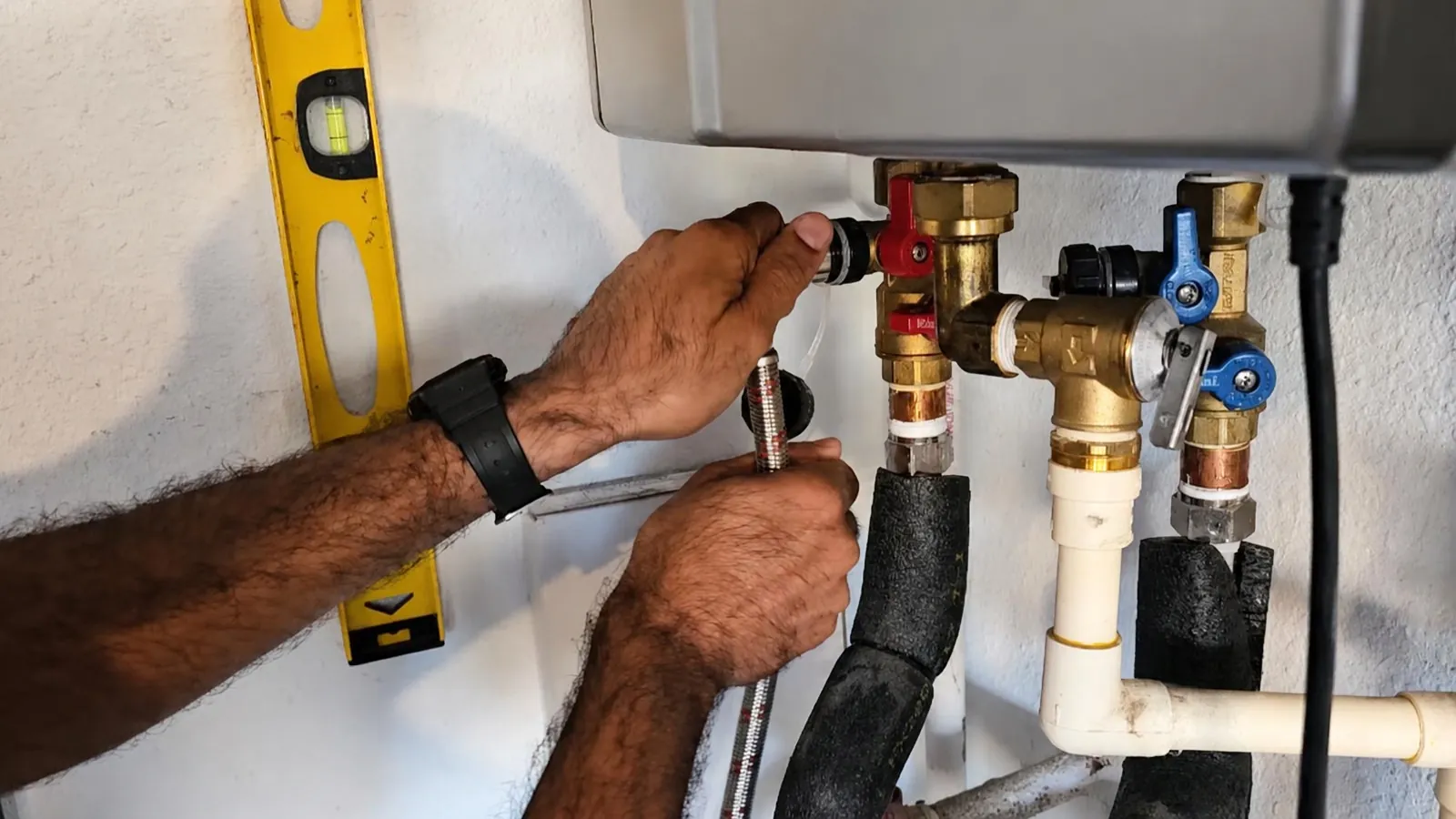
Isolation valves are a pair of shutoffs with service ports on the cold inlet and hot outlet of the heater. They let us flush the exchanger without taking the unit off the wall. Some older installs lack them, and adding them is a modest job that pays back on every service call.
Tankless install: what a good setup includes
A tankless install is not a like-for-like swap. The house has to support the unit.
Gas-fired unit
- Gas line sized for the higher burner load
- Proper vent path to the outdoors
- Condensate drain on condensing models
- Isolation valves and a reachable inlet screen
Electric unit
- Heavy-duty circuit and breaker capacity
- Panel room for the added load
- Isolation valves and a reachable inlet screen
- Realistic flow for the number of simultaneous taps
Repair, replacement and where the money goes
Most tankless repairs are cleaning, sensors, igniters or flow parts. A badly scaled exchanger can be beyond descaling, and that is a conversation about replacement. If the unit is the problem, our water heater replacement page explains the process, and planned installation covers the house-side work.
A softener upstream of the heater cuts scale at the source, and our softener and filtration page explains what it does and does not do. Homes in Picture Rocks, in unincorporated Pima County, follow County permit rules. See our Picture Rocks page.
The Town of Marana adopted the 2024 International Plumbing Code (IPC) and the International Fuel Gas Code with local amendments, and a gas tankless unit touches both through its venting, gas line and drain, so confirm permits before the work starts.
What drives the cost of tankless service
A flush and a full install are very different jobs, and the price follows the job.
Frequently asked questions
It depends on your system. Gladden Farms averages about 9 GPG, Picture Rocks and Saguaro Bloom about 12, Hartman Vistas about 5, and the Airport system about 14. Check your bill or the Town lookup.
Follow the manufacturer's manual. Hard-water homes are usually flushed more often than the minimum it lists.
It is difficult. We recommend adding isolation valves, which also makes future flushes quicker.
Not necessarily. It may be scaled, the inlet screen may be clogged, or the demand may exceed the unit's flow rating. A flush and a flow check sort it out.
No. It is a low urgency, planned service. If the unit is leaking or smells of gas, treat that as an emergency and call 911 and the gas utility first.
Softened water reduces scale on the heat exchanger. It does not remove the need for service, since other debris and wear still happen.
Marana lists water heater replacement under its permit application process with a safety inspection. Contact Development Services at (520) 382-2600. Pima County handles unincorporated areas.