
When a hidden leak is an emergency
Water that is actively soaking a ceiling, pooling on the floor, or running in a wall will not wait for a business day, and our 24/7 line is open for exactly that. While you wait for a call back, the goal is to stop more water from getting in and keep electricity away from it. If water is spraying from a pipe rather than seeping, treat it as a burst pipe and close the main first.
- Shut off the main water valve at the house or at the meter, then open one faucet to relieve pressure.
- If water is near outlets, a panel, or light fixtures, switch off power to that area at the breaker only if the breaker is dry and you can reach it safely.
- Stay out from under a bulging or dripping ceiling, since wet drywall can drop without warning.
- Move rugs, furniture, and electronics away from the wet spot.
- Take photos and short videos of the damage and the meter for your records.
Check your meter in about thirty minutes
You can learn a lot before anyone arrives. This test tells you whether water is leaving the system at all, which is the first question a plumber will ask.
- 1
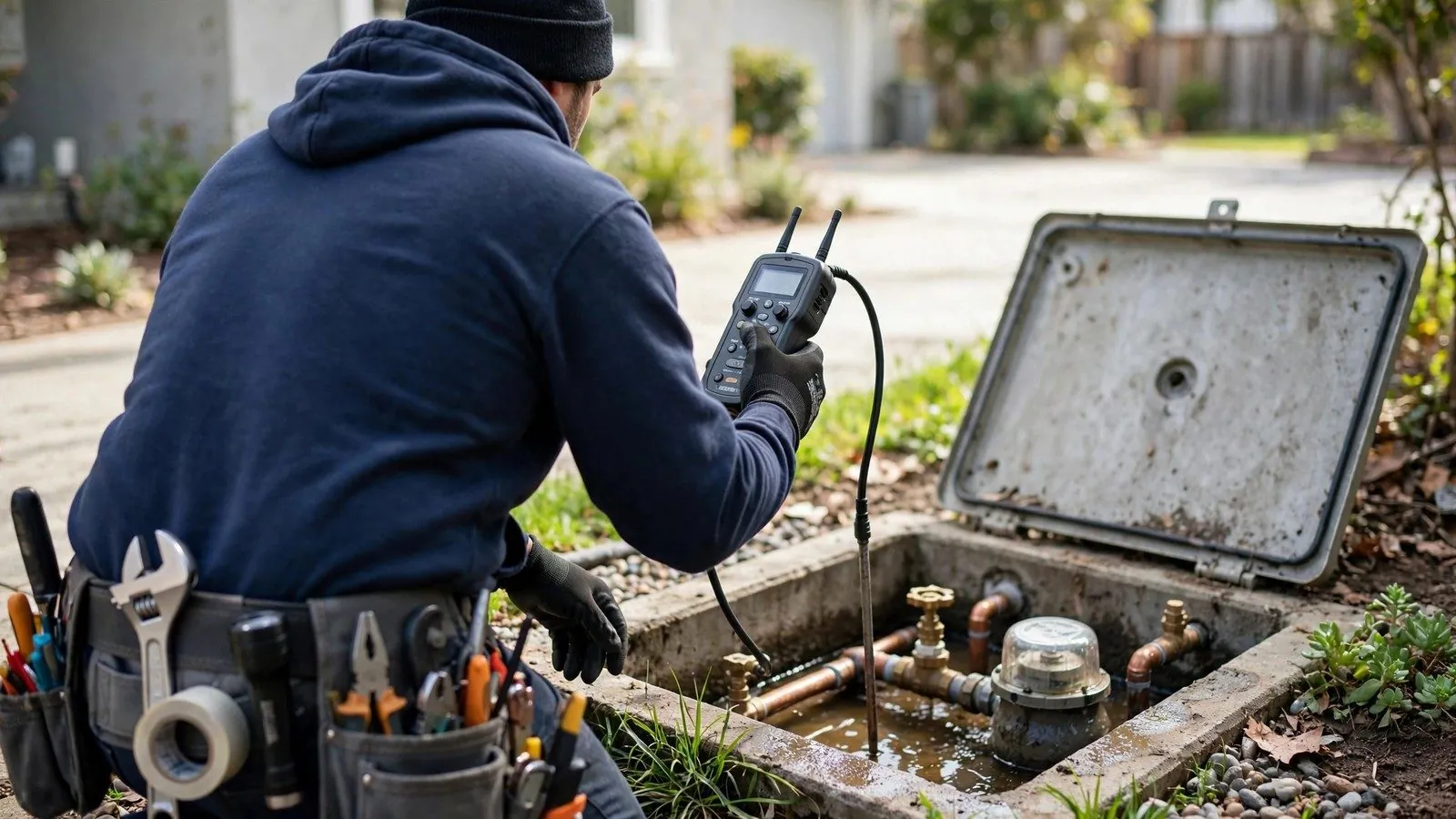
Find and open the meter box
It is usually a ground-level box near the street or the front of the lot. Lift the lid with a screwdriver rather than your fingers, because spiders and scorpions like those boxes.
- 2
Turn off every use of water
Close all faucets, pause irrigation timers, and stop the dishwasher and washing machine. An ice maker or water softener can also pull water on its own.
- 3
Look at the low-flow indicator
Most meters have a small triangle, star, or wheel that spins at very low flow. If it moves with everything off, water is going somewhere.
- 4
Write down the register reading
Note the numbers on the main dial exactly as they read, along with the time. A photo works just as well.
- 5
Wait, then read it again
Wait at least 30 minutes without using any water, and longer is better. If the numbers have advanced, you have a leak somewhere past the meter.
- 6
Close the main and test once more
Shut the valve at the house and watch the indicator. If it stops, the leak is inside the house. If it keeps moving, the loss is on the meter side, so say so when you call.
Why the water bill suddenly climbed
A summer bill is naturally higher because irrigation runs more in heat, and Tucson averages highs near 100 degrees in June and July. So a higher bill alone proves nothing. What matters is a number that does not match how the household used water, or a meter that moves overnight.
Not every moving meter is a pipe leak. A toilet flapper that no longer seals can run quietly for days, and scale makes that more likely. Marana's systems range from roughly 3 to 14 grains per gallon depending on the neighborhood, so the harder your address, the faster deposits can foul flappers, fill valves, and shutoffs. Food coloring in the tank will show a leaking flapper within fifteen minutes.
Meter still moving? Call now
Tell us what the meter test showed and we will plan the search. (855) 575-2890
How a hidden leak actually gets found
No single tool finds every leak. A good search stacks a few methods, and each has limits that are worth hearing before work begins.
| Method | What it tells us | Honest limit |
|---|---|---|
| Meter test | Confirms water is leaving the system at all | Does not say where, and tiny leaks can hide in normal use |
| Pressure test | Isolates a line or section, then watches a gauge for a drop | Narrows the zone but needs the line capped or isolated first |
| Acoustic listening | Sensitive microphones pick up the hiss of pressurized water in a pipe | Hard to use over noisy ground, and sound can travel along the pipe to a misleading spot |
| Thermal imaging | Shows temperature differences, such as a hot water line warming a floor | Only helps when the leak has a heat or moisture pattern, and cold lines are harder to read |
| Tracer gas | A harmless gas mixture is pushed into the emptied line, and a sensor finds where it escapes | Takes longer to set up and slow seepage through thick concrete can blur the reading |
| Camera inspection | A small camera looks inside drain lines or through a small opening | Shows what is in front of the lens, so it suits drains better than pressurized supply lines |
A stain on the ceiling or a damp wall
A brown ring on the ceiling, a bubble in the paint, or a soft spot in drywall means water has been present for a while. The stain is only where the water arrived. The source can sit several feet away, because water follows framing, ducts, and insulation before it drips.
In summer, attics reach very high temperatures, and supply lines and water heaters often sit up there. A slow leak at a fitting or a failed connection can drip onto insulation for weeks before the ceiling shows it. We trace the stain back along the likely path, check fittings and any air conditioning condensate lines nearby, and test the supply to see whether it is plumbing at all.
Water under the house or under the floor
A warm patch on tile, water seeping at the edge of a garage slab, or the sound of running water in a quiet room points to a line in or under the concrete. Pipes under a slab cannot be seen, so the search relies on listening, heat patterns, and pressure checks to narrow the spot before anyone cuts anything. Our page on slab leak repair options explains what comes after the location is known.
If your home has a raised floor or a crawl space, access is easier and the search often goes faster. Either way, a warm spot or a persistent damp smell deserves a call soon.
Buried lines between the meter and the house
The line that carries water from the meter to your house is buried, and a leak there rarely shows until the ground turns soft or the meter will not stop. Hard desert soil can hide the wet spot, because water may travel along harder layers and surface well away from the break. Our guide to water service line repair covers trench and trenchless options in detail.
Before any digging, Arizona 811 asks you to call 811 or visit Arizona811.com at least two working days ahead. It is free and it is the law. Where utility responsibility ends and yours begins varies by address, so ask Marana Water at (520) 382-2570 if you are unsure which side of the meter the problem is on.
Irrigation leaks that waste water all season
Drip lines, zone valves, and sprinkler heads are a common source of a high bill that never shows indoors. A valve that fails to close can leak into a zone for hours. Brief winter freezes, about 12 days a year at or below 32 degrees in Tucson, can crack exposed fittings and backflow assemblies. Run each zone and watch for pooling, hissing, or a meter that moves faster than the zone should draw.
What to do before you call about a hidden leak
- Shut off every fixture and check whether the water meter dial still moves.
- Photograph damp spots, stains and warm floor areas with a date so you can show them later.
- Do not cut into drywall or flooring yourself before the leak is located.
- Know where your main shutoff is so you can close it if the leak worsens.
Pool, spa, and yard leaks
For pools and spas, a bucket test is the usual first step. We look at the plumbing side, such as supply, return, and fill lines, and we cannot judge a cracked pool shell or equipment issues, which belong with a pool specialist.
A wet spot around the meter box or a constant trickle in the yard may be on the utility side of the meter. In that case, call Marana Water, and for after-hours leaks the number is (520) 235-4381. If the water is on your side, we can pinpoint it. Finding a leak is one step and fixing it is another.
A repair that opens a wall or slab in Marana may fall under the 2024 International Plumbing Code (IPC) the Town has adopted, so ask whether a permit is needed.
What drives the cost of finding a leak
Locating a leak is priced by the work involved, not by a flat figure, because a quick meter and fixture check is very different from tracing a line under concrete.
Frequently asked questions
Yes. Our emergency line is open 24/7, including nights, weekends, and holidays, for active leaks and water you cannot stop. We cannot promise an arrival time, so shut off the water and follow the steps above while you wait.
It means water is leaving the system somewhere past the meter. Check the toilets with dye first, since that is the most common quiet leak. If the meter still moves with the house main closed, the leak is on the meter side of that valve, and if it stops, the leak is inside the home.
We can usually narrow the location without cutting anything, using listening equipment, thermal imaging, and pressure tests. Cutting happens only after the spot is identified, and it is limited to that area. In some cases a result is a zone rather than an exact point, and we say so.
Not directly, but scale can wear on fill valves, flappers, and shutoff valves, and corrosion of fittings can shorten their life. The Town's May 2026 table shows hardness varying by neighborhood, from roughly 3 to 14 grains per gallon. Check your water bill or the Town lookup to see which system serves your address.
Yes, we serve the area from our Marana base. See our page for Picture Rocks plumbing service for local details, including that permits there come from Pima County rather than the Town of Marana.
Do not wait on a wet floor
A leak that is found early costs less to repair than one that spreads. Call (855) 575-2890 any hour.
Call (855) 575-2890