
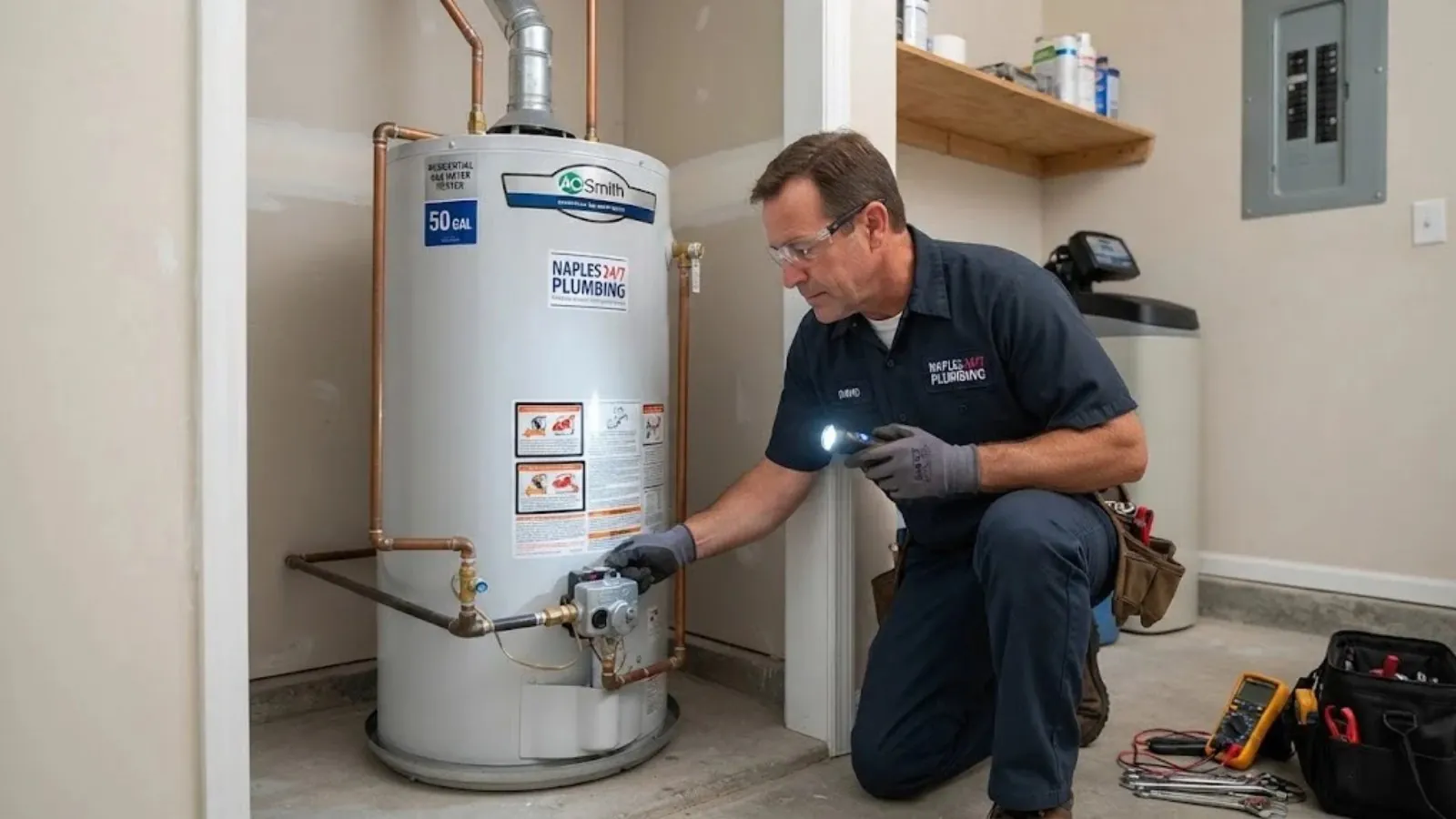
Signs an element has failed
Check these before you buy parts. Most electric tanks have two elements, one high and one low.
No hot water at all
If the upper element or its thermostat fails, the whole tank can stay cold. Check the breaker and the reset button first.
Lukewarm water that runs out fast
A dead lower element often leaves you with only the top third of the tank hot, so showers run cold quickly.
Breaker trips when the heater runs
A shorted element can leak current to the tank and trip the breaker. Stop using the heater until it is checked.
Crackling or popping
Mineral scale on the element can make noise as water boils under the crust. It is often a sign of scale, not just a bad element.
Marana heat and water, and your element
NWS Tucson 1991 to 2020 normals put average highs near 101 F in June and about 100 F in July. Many Marana heaters sit in garages or attics, where summer air is hotter still. Give yourself time to let the tank cool and work early in the day.
Town of Marana Water lists several systems, and the hard ones read about 12 GPG, with the airport system at 13 to 15. Hard-water homes tend to build scale on elements faster, so pull the old element and check the crust to see how fast your tank scales.
Marana lists water heater replacement under its permit application process with a safety inspection. An element swap is a repair, but if you are unsure where the line sits, confirm with Development Services at (520) 382-2600.
Safety before you touch a wire
Water and 240 volt power are a dangerous pair. Do every item before the access panel comes off.
- Turn off the water heater breaker, then confirm at the heater with a non-contact tester and a multimeter that the wires are dead. A breaker label can be wrong.
- Wait for the tank to cool. Water inside can be hot enough to scald for hours.
- Never power the element while it is out of water. A dry element burns out in seconds.
- Wear gloves and eye protection, and keep a bucket and towels ready.
- Work with a helper if the heater is in an attic. Summer attic heat and a ladder are a poor mix.
- If you smell gas or the unit is gas-fired, stop. This guide is for electric tanks only.
The replacement, one step at a time
Match the new element to the old one by volts, watts and thread style. The data plate on the heater lists the rating.
- 1
Cut power and shut the cold supply
Switch off the breaker, verify dead, then close the cold inlet valve on top of the tank.
- 2
Connect a hose and open a hot tap
Attach a hose to the drain valve and run it to a floor drain or outdoors. Open a hot faucet in the house so air can enter and water can leave.
- 3
Drain below the element
Open the drain valve. For the upper element, drain until the tank is a bit below it. For the lower, drain the tank fully. Scale can clog the valve, so stop and call if it will not flow.
- 4
Remove the panel, insulation and wires
Take photos of the wiring first. Disconnect the wires and note which terminal each came from.
- 5
Unscrew the element
Use an element wrench or deep socket and turn counterclockwise. A seized element can break, which is one point to stop and call.
- 6
Clean and fit the new one
Wipe the tank opening, fit the new gasket, thread in the element by hand and snug it with the wrench.
- 7
Refill completely
Close the drain, open the cold inlet, and leave the hot tap running until water flows steadily without air spitting. Check for drips at the element.
- 8
Restore power last
Reconnect the wires, replace insulation and panel, then switch the breaker on. Give the tank time to heat.
Testing the element and thermostat
Test with power off and the wires removed from the element. Set a multimeter to ohms.
| Test | Normal reading | If it reads otherwise |
|---|---|---|
| Across the two element terminals | A few ohms up to about 15, depending on watts | No reading or open means a failed element |
| One probe on a terminal, one on the tank | No reading (open) | Any reading means a short to ground, replace it |
| Thermostat and high-limit reset button | Power passes through once reset and cooled | No power through usually points to a thermostat or high-limit fault |
Readings vary with element wattage, so compare with the label on the element or heater. If the numbers confuse you, that is a good time to hand it to a plumber.
Why elements fail in hard water
Minerals in the water bake onto the hot surface of the element and form a crust. The crust traps heat, and the element can overheat and burn out. A flush now and then and clean new parts help, but a softener addresses the cause.
A replacement element can last a long time if the tank is free of heavy scale and sediment. If the tank is old and crusty, the new element may fail again sooner. That is a good moment to compare repair against replacement.
Fix it yourself or call
Be honest about the job and your tools.
| Situation | Reasonable for DIY | Call a plumber |
|---|---|---|
| Comfortable with power, tools and a multimeter | Yes, with all precautions | Optional |
| Drain valve clogged by sediment | No | Yes |
| Element is seized or breaks off | No | Yes |
| Tank leaks from the shell or bottom | No | Yes, likely replacement |
| Breaker keeps tripping after a new element | No | Yes |
| You are unsure about the wiring | No | Yes |
When to call a plumber
Call if you cannot verify the power is off, the drain valve will not flow, the old element will not unscrew, or water leaks from the tank itself. A leak from the shell cannot be repaired, and the tank will need to be replaced.
Our water heater repair visits cover element and thermostat faults. If the tank is old, we can also talk through a water heater replacement, including permit steps, and homes in Picture Rocks follow Pima County rules rather than the Town's. Element swaps are maintenance, but the relief valve and discharge line on the tank are what the 2024 International Plumbing Code (IPC), as adopted in Marana, cares about, so check them while the heater is open.
Frequently asked questions
No. The element sits below the water line, and removing it from a full tank lets pressurized hot water pour out of the opening. Drain below the element first.
Test at the heater's wires with a non-contact tester and then a multimeter. Labels on panels are sometimes wrong, and a tester is the only proof.
The element can burn out in seconds because water carries the heat away. Open a hot tap and wait for a steady stream before restoring power.
Scale on the element and on the tank bottom can make popping sounds. Hardness in Marana systems ranges widely, from roughly 3 to 14 grains per gallon depending on the neighborhood, so the noise can start sooner in harder areas.
Yes. Match the voltage, wattage and thread or mounting style on the old part. A wrong wattage can overload the circuit or the tank.
It can be. Garage and attic air runs hot in summer, so work early, drink water and have a helper nearby.
Still deciding? Call the 24/7 line.
A person answers, listens to the problem, and tells you what happens next.
Call (855) 575-2890