
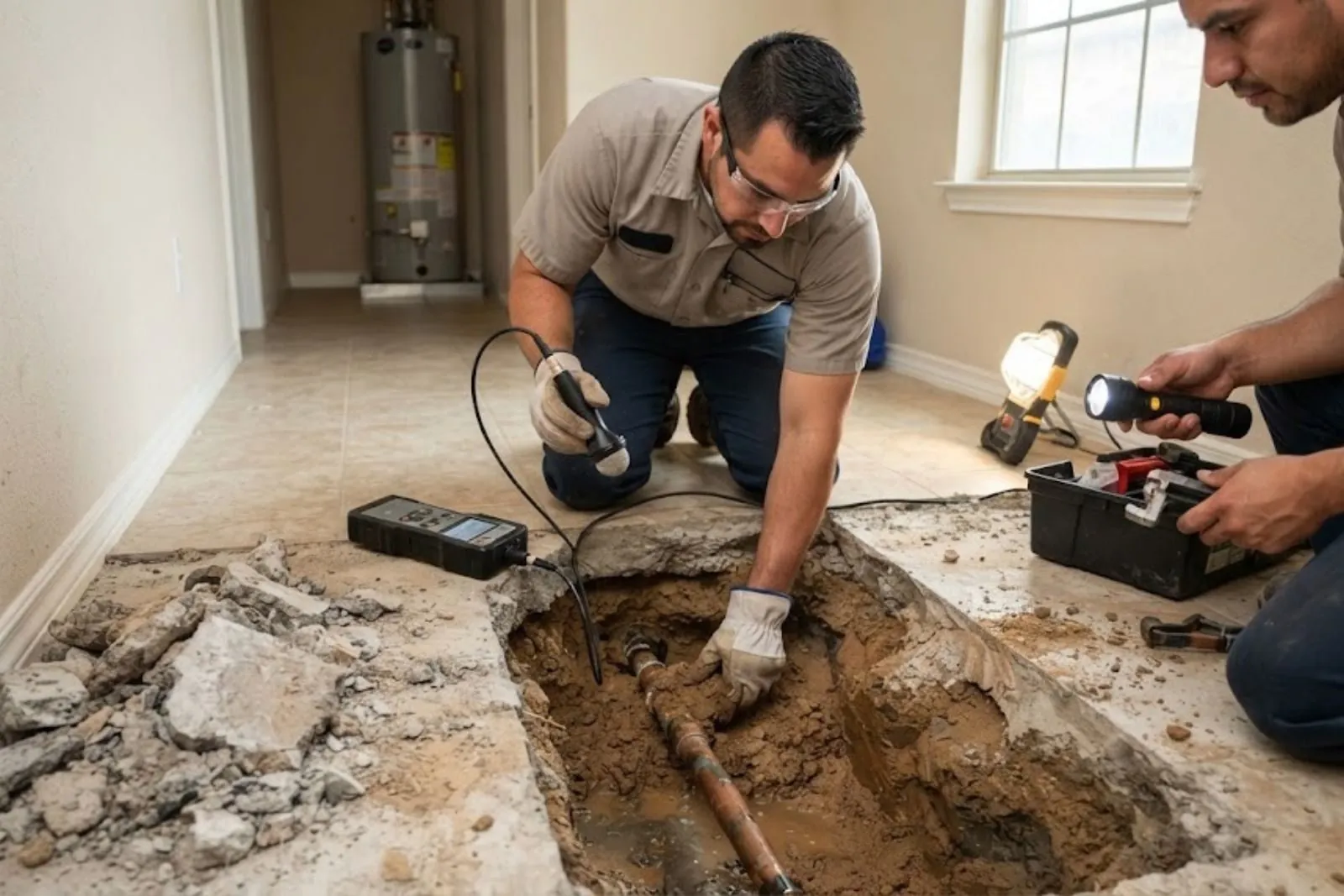
Prove it is a slab leak first
Run through these checks before anyone saws concrete. They take less than an hour and can save a lot of money.
- Turn off every fixture, appliance and irrigation zone, then look at the water meter. A moving dial or spinning leak indicator with everything off means water is escaping somewhere.
- Close the main shutoff to the house and watch the meter again. If it still moves, the leak is between the meter and your shutoff, which is the service line and not a slab leak.
- Feel the floor for a warm spot, especially on tile. A hot-water line leaking under the slab can warm the floor above it.
- Listen at night for a faint hiss or running sound with all water off.
- Look for damp baseboards, a musty smell, lifted flooring, or water at the edge of the garage slab.
- Check the water heater, toilets and hose bibs for slow drips that could explain the meter.
How a plumber pinpoints the spot
Pinpointing matters because it decides how big the hole is. Technicians use pressure tests to find which line is losing water, then electronic listening equipment, thermal imaging on hot lines, and sometimes tracer gas to mark the exact point. Our leak detection work follows that order so the cut, if one is needed, is small.
Ask to see the readings or a marked floor before any cutting starts. A confident answer includes which line is leaking, hot or cold, and roughly how far from a wall.
Permits and codes for slab work in Marana
Marana's Town Code section 7-1-2 adopts the 2024 International Plumbing Code (IPC) with local amendments. Rerouting or replacing supply piping falls under that code, so ask your plumber how the work will meet it.
Permit rules vary by job, so call Town Development Services at (520) 382-2600, open for customer service Monday through Friday 8 AM to 5 PM, before work begins. Inspections run 7 AM to 3 PM, which matters if you are scheduling around a day off.
In unincorporated Pima County, such as much of Picture Rocks, the county's Do I Need a Permit page lists new pipe work as requiring a permit. Confirm with the county rather than assume the Town's rules apply.
The four options side by side
No option wins every time. This table shows what you give up with each.
| Option | Best when | Main trade-off |
|---|---|---|
| Spot repair under the slab | One leak, accessible location, otherwise sound pipe | Opens flooring and concrete, other leaks may follow |
| Reroute through attic or walls | A line is failing or hard to reach under the slab | Drywall and paint work, new pipe visible in some spaces |
| Whole-house repipe | Several leaks or pipe at the end of its life | Largest job, most disruption, longest timeline |
| Epoxy lining | Pipe is intact but pitting, and few tight bends | Not suited to every pipe, will not fix a split or a joint |
Your plumber should explain why one option fits your pipe and not the others. If the answer is the same for every house, ask more questions.
Spot repair or reroute: the usual first decision
Most Marana slab leaks come down to these two. Rerouting avoids the slab, while spot repair keeps your existing layout.
Spot repair under the slab
- Cut the concrete over the leak, replace the bad section, patch the slab
- Needs floor covering removed above the cut
- Works well for a single clean failure
- Leaves old pipe under the slab that may leak again elsewhere
Reroute through attic or walls
- Run new pipe overhead and abandon the old under-slab section
- Avoids breaking concrete
- Makes future repairs easier to reach
- Attic pipes see summer heat, so insulation and routing matter
What to do while you wait for the repair
A slab leak can run for weeks without showing. These steps limit the damage.
- 1
Close the main water valve
If the floor is wet or flooring is lifting, shut the house main. Water running under a slab can undermine soil and damage flooring.
- 2
Move belongings off the floor
Pull rugs, boxes and furniture legs off wet areas. Photograph everything before and after.
- 3
Document the meter
Photograph the meter dial with everything off, then again an hour later. Your insurer and your plumber will both ask for it.
- 4
Call our 24/7 line
Call (855) 575-2890 and describe the warm spot, hiss or wet edge. Keep the main off if water is visible.
Insurance: a hedge, not a promise
Homeowners policies often cover sudden water damage but may exclude the cost of repairing the pipe itself, or treat a slow leak as wear. Some policies cover access costs such as opening the slab and others do not.
Read your policy for terms like slab, foundation and tear-out, and call your insurer before work begins if you plan to file. Ask the plumber for a written description of the cause and the repair, since adjusters usually want it.
When to call and when to wait
Use this to sort urgency.
| What you see | How urgent | Next step |
|---|---|---|
| Water coming up through the floor or at the slab edge | Urgent | Close the main, call the 24/7 line |
| Meter moves with everything off, floor is dry | Soon | Run the main shutoff test, book detection |
| Warm floor spot, no other signs | Soon | Call for pinpointing, keep an eye on the meter |
| Slightly higher bill only | Check first | Rule out toilets, irrigation and drips |
Questions worth asking any plumber
These help you compare quotes fairly.
- How did you confirm the leak is under the slab, and which line is it?
- Which options fit my pipe, and why did you rule others out?
- How much flooring will be opened, and who restores it?
- Is the contractor's license class right for the work? Check it at roc.az.gov.
- Who pulls the permit and schedules the inspection?
- Is the price clear before work starts, and does it list the access and patch work?
When to call a plumber
Call for any confirmed or suspected slab leak. Cutting concrete, rerouting supply lines and judging pipe condition are not weekend DIY jobs, and a wrong guess about the location can mean extra holes in your floor.
For homes in Picture Rocks, the permit comes from Pima County instead of the Town, so ask your plumber which jurisdiction applies to your property.
Frequently asked questions
No, but it is a common sign when a hot-water line leaks under the concrete. A heater in the wall, sun through a window or a radiant source can also warm a floor. Pair the warm spot with the meter test before deciding.
Something is leaking, but not necessarily under the slab. Toilets, irrigation valves and the service line can all cause it. Closing the main and watching the meter tells you whether the leak is on your side or the street side.
Most newer Marana homes are built on concrete slabs, so supply and drain lines often run in or under the slab or through attics. Your home may use either layout, which affects the options available.
A long-running leak can soften the soil under a slab and stain or lift flooring. We do not diagnose structural problems, so if you see cracks or doors that stick, ask a structural professional.
Heavy monsoon rain can mask a damp spot near the slab edge, so a wet patch outside after a storm is not always from the storm. The meter test works in any weather.
Not always. One leak on otherwise healthy pipe can be fixed in place. Several leaks, or pipe that is failing in more than one spot, make repiping worth pricing.
Still deciding? Call the 24/7 line.
A person answers, listens to the problem, and tells you what happens next.
Call (855) 575-2890