
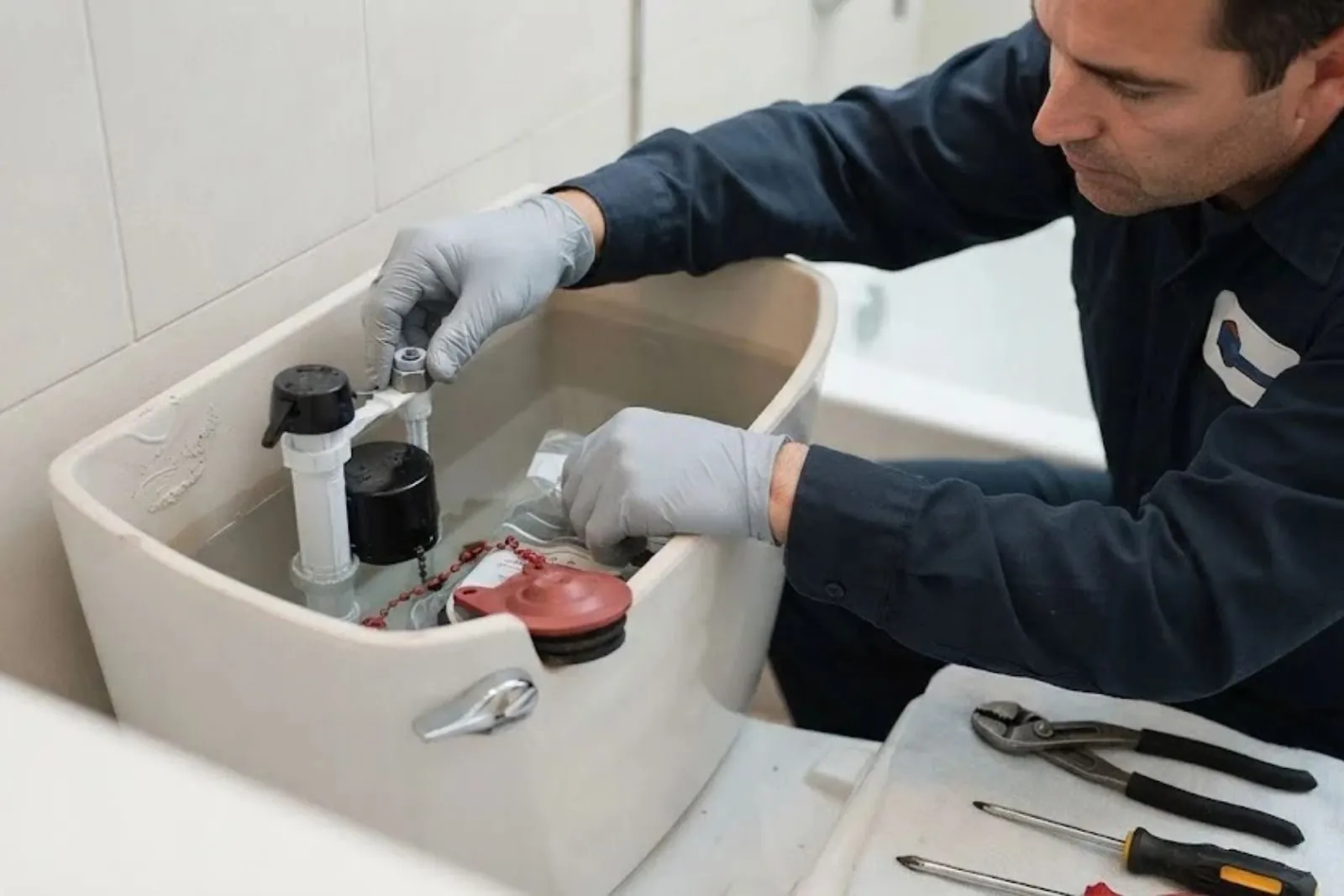
Five signs the fill valve is the problem
The valve sits on the left side of the tank in most toilets. Each of these symptoms points to it, though not always to the same fault.
Constant hissing
A steady hiss after the tank is full means the valve is not closing all the way. Water keeps trickling in.
Tank refills by itself
If the tank tops up every few minutes with no flush, water is escaping somewhere. A worn seal in the valve is one suspect.
Slow fill after a flush
A long wait before the toilet is ready again often means scale or debris is blocking the valve inlet.
Tank will not fill
No refill at all can mean a closed shutoff, a stuck float or a valve clogged solid.
Water running into the overflow tube
If water spills down the tall tube in the middle of the tank, the float is set too high or the valve is failing.
Why Marana hardness matters for toilet parts
Marana Water runs several separate systems, and the Town's May 2026 hardness table shows different readings by neighborhood. Gladden Farms and the Tangerine corridor average about 9 grains per gallon, with a range of 6 to 12. That is enough to leave white scale on valve seals, so plan to inspect a fill valve every few years.
The airport system sits at the hard end, at roughly 13 to 15 grains per gallon, while the Picture Rocks and Airline/Lambert systems average about 12. Homes there may see scale in a fill valve sooner than homes in the Hartman Vistas area, which averages about 5. If you are in Picture Rocks, our Picture Rocks plumbing page has the local water details.
Check your own provider on your water bill or the Town's service-area lookup, since providers differ by address. The Town notes that hardness poses no health risk, but it leaves deposits on fixtures. In practice, that means a spare fill valve and a yearly look inside the tank are worth the few minutes.
How to shut off the water and set up
Prepare the space first, since an old toilet can drip more than you expect.
- 1
Find the shutoff valve
It is the small oval or round handle on the wall or floor behind the toilet. Turn it clockwise until it stops, and do not force a stuck handle.
- 2
Flush and drain the tank
Hold the handle down so the tank empties. Sponge out the last inch of water so the work area stays dry.
- 3
Disconnect the supply line
Place a towel and a small bucket under the connection. Unscrew the coupling nut under the tank, then the supply line from the shutoff.
- 4
Take a photo
A quick picture of the old valve, chain and flapper helps you match parts at the store and remember how things were set.
Replacing the fill valve step by step
Most universal fill valves fit the standard tank hole and adjust in height. Read the package directions, since models differ.
- 1
Remove the old valve
Unscrew the large locknut under the tank and lift the valve out. Pull the small refill tube off the overflow pipe clip.
- 2
Set the new valve height
Adjust the shaft so the top of the valve sits at the height the instructions give, usually an inch or two above the overflow tube.
- 3
Seat it in the tank
Drop the valve through the hole with its rubber washer in place. Hand tighten the locknut from below, then add a quarter turn only.
- 4
Reconnect the supply line
Thread the coupling nut onto the new valve by hand, then snug it with pliers. Over tightening cracks plastic parts.
- 5
Attach the refill tube
Clip the small tube to the overflow pipe so it points into the pipe and not into the water. Do not push it down into the tube.
- 6
Turn the water on slowly
Open the shutoff and watch the connections. Let the tank fill, check for drips, then adjust the float until the water stops about an inch below the top of the overflow tube.
Fill valve types and what to expect
Pick a style that suits your tank. Matching the old one is usually the simplest route.
| Style | How it works | Good for | Watch for |
|---|---|---|---|
| Float cup | A cup slides up the shaft with the water level | Most modern toilets | Scale can make the cup stick |
| Ballcock with arm | A float ball on a metal arm lifts as the tank fills | Older toilets | Arm and ball corrode and need adjusting |
| Diaphragm | A rubber diaphragm opens and closes the flow | Some older brass valves | Diaphragm hardens and cracks |
| Pressure assist | A sealed pressurized tank inside the porcelain tank | Some commercial style fixtures | Needs a plumber, not a DIY swap |
Hard-water scale in valves and fittings
Scale builds up inside the small passages of a fill valve. It also coats the seal, so it no longer closes tightly. A valve that ran fine for years may suddenly hiss or run slowly once the scale reaches a certain thickness.
A quick rinse can help. Unscrew the cap of a cup-style valve, hold it away from your face, and flush a little water through it into a bucket. If the valve still behaves, replace it. Valves are inexpensive and the labor is mostly your own time.
Before you call a plumber, check these
A short check can save you a trip, or confirm that the problem needs more than a part swap.
- The shutoff valve turns fully and does not drip at the stem.
- The supply line has no kinks, and the connections are dry.
- The float or cup moves freely and is not rubbing the tank wall.
- The refill tube clips into the overflow pipe and does not sit below the water line.
- The flapper seats flat and the chain has a little slack.
- There is no crack in the tank or bowl, and the base is dry.
When to call a plumber
Some toilet jobs go beyond a simple swap, and an honest assessment saves money and mess.
| Situation | Likely cause | Right next step |
|---|---|---|
| Shutoff valve will not turn or leaks | Corroded or scaled valve stem | Call a plumber, since forcing it can break it |
| Water leaks at the base of the toilet | Failed wax ring or loose bolts | Call for toilet repair |
| Tank cracked or leaking from the bolts | Damaged tank or hardware | Replace parts or the toilet |
| Several fixtures have low water flow | Problem outside the toilet | Have the supply and pressure checked |
| New valve still runs | Flapper, seat or float adjustment | Re-test or request a visit |
A running toilet wastes water and raises the bill, so do not let it go for weeks. If the water will not shut off and the floor is getting wet, close the main valve and call our 24/7 line.
Where this fits with your other fixtures
The same hard-water scale that clogs a fill valve also builds up in faucet aerators and cartridges. If you plan a toilet repair, check the nearby sink as well. Our faucet repair page covers those fixes.
If you are comparing a part swap to a larger fix, our toilet repair page explains when a leaking base, a cracked tank or repeated clogs call for a professional. If a fill valve keeps failing, it helps to know the Town of Marana adopted the 2024 International Plumbing Code (IPC), which expects a working anti-siphon fill valve in a toilet tank, so replace it with an equivalent part.
Frequently asked questions
Most often the fill valve is not closing fully, or scale has built up on its seal. A short hiss while the tank fills is normal. A hiss that continues after the tank is full is not.
Usually under a minute or two for a standard tank. If it takes much longer, check the shutoff valve and look for scale blocking the fill valve inlet.
Yes, if the shutoff valve works and you are comfortable with a wrench and pliers. Take a photo first, buy a matching style, and do not over tighten plastic parts.
Scale can build up on seals and in small passages, so fill valves and flappers may need replacing sooner in harder water areas. Rinsing the valve can extend its life a bit.
Check the float height, the refill tube position and the flapper. If the water level reaches the overflow tube, lower the float. If the problem continues, request a plumbing visit.
Yes. A toilet that runs all day wastes water and raises the bill, and a failing valve can eventually stop shutting off at all. A new valve is a small job compared with that waste.
Toilet still not right?
Call (855) 575-2890 and we will sort out the valve, flapper or fixture.
Call (855) 575-2890