
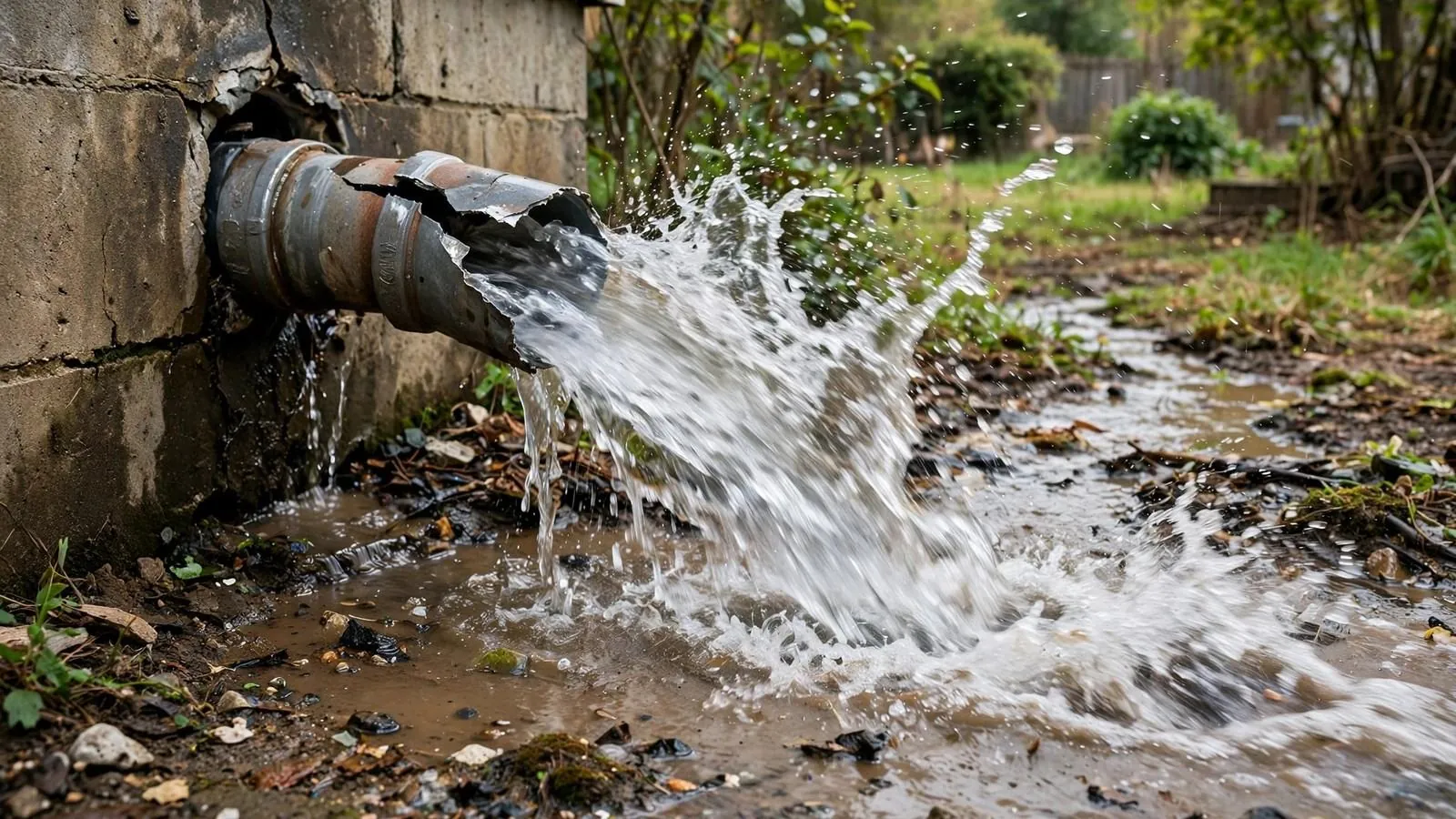
A pipe has burst and water is still running
Take the first minutes calmly and in order. Our 24/7 line is open, and a quick call while you work through this list helps us plan the repair.
- Close the main shutoff valve at the house or at the meter. Turn it clockwise until it stops.
- Open the lowest faucet in the house and the highest to drain what is left in the lines.
- Switch off the water heater. Cut power to wet rooms at the breaker only if the panel is dry and you can reach it safely.
- Stay away from outlets, appliances, and anything electrical standing in water.
- Move valuables and soak up standing water if it is safe to do so.
- Photograph and film the damage before cleanup.
Document it now for your insurer
Sudden pipe bursts are often treated differently from slow leaks, so a clear record helps. Do this before you move too much.
- Wide photos of each wet room, then close-ups of the broken pipe and any stains.
- A short video of the water source before and after it is shut off.
- The time you first noticed it and the time you closed the main.
- A photo of the meter dial after shutoff.
- A list of damaged belongings with rough age and purchase detail.
- Keep receipts for any emergency supplies and for our work.
Water still flowing? Call now
Close the main, then call. (855) 575-2890
Why pipes crack in a desert town
Tucson sees about 12 days a year at or below 32 degrees, so a freeze is brief and rare but real. Water expands as it freezes, and that stress is enough to split a pipe wall. Exposed outdoor lines, hose bibs, irrigation backflow assemblies, and anything in an unheated garage are the usual victims, and the split often shows only after the thaw.
Heat does damage too. In summer, attics get very hot, and supply lines up there expand and contract with each use. Fittings can loosen or crack over the years. If a pipe in your attic fails, water usually shows up first as a ceiling stain.
Pressure and water chemistry matter as well. Excess pressure strains joints and valves, and Marana's hard water, roughly 3 to 14 grains per gallon depending on the neighborhood, leaves scale that can restrict flow and corrode some fittings.
A cracked or broken pipe versus a slow pipe leak
A cracked or broken pipe throws water quickly, and the signs are loud: spraying, a rush of sound in the wall, or a sudden loss of pressure. A pipe leak is slower, such as a pinhole weeping at a fitting or a seep that stains drywall over weeks.
Both need repair, but the first has to be stopped at once. If the meter moves and you cannot see a source, read about leak detection to find where the water is going.
Repair approach by pipe and location
What we do depends on what the pipe is made of, where it runs, and how the rest of it looks.
| Pipe or location | Typical repair | What to know |
|---|---|---|
| Copper supply line | Cut out the damaged section and join new pipe with soldered or mechanical fittings | Copper pipe repair is quick when the rest of the line is sound, but widespread pitting means a bigger scope |
| Plastic supply line (such as PEX) | Replace the split section with approved fittings | Often simple to access in attics and walls, though sunlight and heat exposure should be checked |
| Drain pipe | Replace the cracked section so wastewater stays inside the line | A drain pipe repair may call for a camera look first to see how far the damage runs |
| Exterior hose bib or irrigation line | Replace the bib or the damaged run and check the shutoff behind it | Freeze damage can hide inside the wall, so we test after the repair |
| Line in the slab or under the floor | Locate, then spot repair or reroute | See slab leak repair for the options |
A single repair is the right call when the rest of the pipe is healthy. If the same line keeps failing, we tell you honestly and show you the options.
After the water is off: what happens next
Once the flow is stopped, we locate the break, cut back to solid pipe, and make the repair. Then we restore pressure slowly, test every joint we touched, and check nearby fittings for the same weakness.
Water damage is the next step. Drywall, insulation, and flooring that stayed wet can grow mold, so drying matters. We handle the plumbing, and we can tell you what we see so your insurer or a restoration company knows what to address.
When a burst is a sign of something bigger
One failed pipe can be bad luck. Two or three on the same system within a year often means the pipe is wearing out, and a water service line repair or a full replacement may be the better value.
We look at the age, material, and condition of what we see and tell you plainly if more failures are likely. A permanent burst pipe repair in Marana is expected to meet the 2024 International Plumbing Code (IPC) the Town has adopted, so ask whether the fix is temporary or code-compliant and whether a permit applies.
What drives the cost of burst pipe repair
An emergency repair is priced by what is broken and how hard it is to reach, and we give you a clear price before work starts.
Frequently asked questions
Yes. Our line is open 24/7, including nights, weekends, and holidays. We cannot promise an arrival time, so shut the main first and follow the steps above while you wait.
It is often on an exterior wall near the front of the house, in the garage, or at the meter box. Find it before an emergency and test that it turns. A stuck valve is worth mentioning when you call.
Yes, though rarely. Tucson averages about 12 days a year at or below 32 degrees, mostly from November through February. Exposed hose bibs, irrigation lines, and backflow assemblies are the ones at risk, so insulate or cover them on cold nights.
A drip can become a burst, and wet drywall can grow mold in a few days. Shut off the water to that line if you can and call us. If the stain is growing, treat it as urgent.
Yes. A cracked drain lets wastewater seep into the soil or slab, so we replace the damaged section. A camera inspection can show whether the damage is limited to one spot.
It can be over time. Heat makes pipes and fittings expand and contract, and some plastic parts degrade with heat and sunlight. If your supply lines run through an attic, a ceiling stain after hot weather is worth checking.
Pipe split or sprayed?
Close the main, then call (855) 575-2890. Our line is open around the clock.
Call (855) 575-2890