
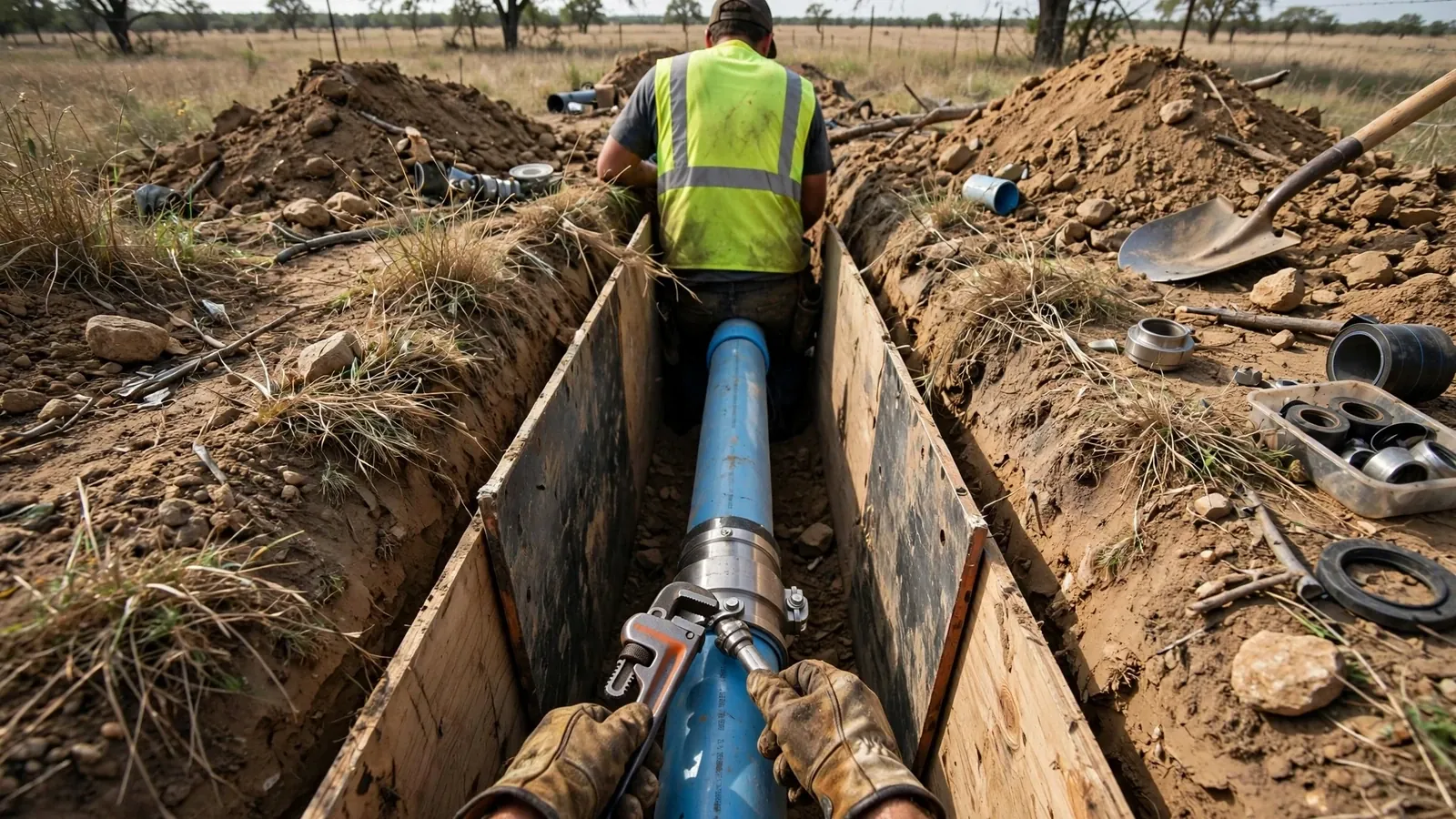
When the line from the meter is leaking or has broken
A buried line that has split can wash out soil, flood a yard, or drop pressure to a trickle. Our 24/7 line is open at (855) 575-2890, and these steps limit the loss while you wait.
- Close the main shutoff at the house. If water keeps running, the loss is upstream of that valve.
- If the leak is on the meter side of your valve, call Marana Water at (520) 382-2570 during business hours, or (520) 235-4381 after hours, weekends, and holidays for leaks.
- Do not dig to find the leak. Buried utilities may be nearby.
- Keep children and pets away from soft, sunken, or flooded ground.
- Photograph the wet area and the meter dial.
How a failing service line shows itself
A buried line seldom announces itself loudly. These are the usual clues.
A wet or sunken patch
Water finds the easiest path up. In hard desert soil it may surface well away from the break.
Meter moves with the house shut off
If the indicator spins after you close the main valve, the leak is between the meter and that valve.
Pressure drops everywhere
A major leak can starve the whole house, including showers and outdoor spigots.
A higher bill with no new use
A steady leak adds up month after month, and it never shows indoors.
Dirty or sandy water
A break can pull soil into the line when pressure changes, so cloudy water can be a warning.
Who is responsible for which side of the meter
The Town says there are several water providers within its limits, so the answer depends on your address. Check your water bill, use the Town's service-area lookup, or ask Marana Water at (520) 382-2570 where the utility's responsibility ends and yours begins.
The meter is the usual reference point for a handoff, but practice varies by provider, so confirm with them before you assume. We can tell you which side of the meter the evidence points to.
Wet ground or a running meter?
Call and tell us what you see. (855) 575-2890
Low water pressure that is not a leak
Weak pressure does not always mean a buried break. A partly closed main valve, a failed pressure regulator, and scale inside old pipes can all do it. Hard water leaves deposits over time, and the Town's table shows roughly 3 to 14 grains per gallon depending on the neighborhood, so scale is more of a factor in some areas than others.
A quick check helps. If pressure is low at every fixture, including outdoors, the cause is at or before the main. If only one fixture is weak, the problem is probably local to it. When the meter also moves with the house shut off, the line is the likely culprit.
Trench or trenchless: choosing the repair
There are two ways to fix a buried line. The best one depends on the soil, what sits above the pipe, and the condition of the line.
| Approach | How it works | Honest trade-offs |
|---|---|---|
| Open trench | Dig down along the pipe, remove the damaged section or the whole run, and lay new pipe | Easy to inspect and connect, but it disturbs landscaping, walkways, and driveways, and hard desert soil slows the digging |
| Spot dig and repair | Dig a small pit at the located break and replace one section | Less disruption, but it only fixes that spot, so it fits a line that is otherwise sound |
| Trenchless replacement | Pull a new pipe through the path of the old one from short access pits at each end | Saves hardscape and landscaping, but needs a straight enough path and suitable conditions, so not every site qualifies |
Where the line crosses a driveway or patio, trenchless can make a big difference. Where it runs through open ground, a simple trench may be quicker and cleaner.
Before any digging starts
Buried lines share the ground with gas, electric, and communication lines. Locating them is a legal step as well as a safety one.
- 1
Call Arizona 811
Call 811 or visit Arizona811.com at least two working days before digging. Arizona Corporation Commission wording says it is free, easy, and the law.
- 2
Wait for the marks
Utilities mark their lines with paint or flags. Do not dig until they have responded.
- 3
Confirm the permit path
Ask Town of Marana Development Services at (520) 382-2600 whether the work needs a permit. For unincorporated areas such as Picture Rocks, permits come from Pima County.
- 4
Locate the break
We pinpoint the leak with a meter test and listening gear before digging, which often keeps the excavation smaller. See leak detection for the methods.
- 5
Repair, test, and restore
We install the new pipe or repair, test it under pressure, and backfill. Landscaping and hardscape repair are discussed up front.
Hard desert soil and the work of digging
Desert ground can be dense and rocky, and hardpan layers slow a shovel and a trencher. That is one reason a located, targeted dig beats a guess. It also means a repair can take longer than the pipe length alone would suggest.
If the line keeps failing
One break on an old line is a repair. Repeated breaks mean the line is wearing out, and replacing the full run from meter to house may cost less over time. When the failures inside the house continue too, it is worth discussing burst pipe repair and a broader plan.
The line from the meter to the house is private plumbing governed by the 2024 International Plumbing Code (IPC) in the Town of Marana, so a repair should be made with approved pipe and fittings and the permit question settled first.
What drives the cost of a service line repair
Underground work is priced by the length, the depth, and what is on top of the line, and we give you a clear price before work starts.
Frequently asked questions
Yes. Our emergency line is open 24/7, including nights, weekends, and holidays. We cannot promise an arrival time, so close the main and use the steps above while you wait.
Close the main valve at the house and watch the meter. If it still moves, the leak is on the line between the meter and the valve. If it stops, the leak is inside the home.
That depends on where your provider's responsibility ends, and Marana has several providers. Ask Marana Water at (520) 382-2570 or the provider on your bill, and review your own insurance policy.
It can be, particularly if pressure is low everywhere and the meter moves with the house shut off. A failed regulator or a partly closed valve can cause the same thing, so we check those too.
Yes. Arizona law asks for a call to 811 or a visit to Arizona811.com at least two working days before digging. Utilities then mark their lines so the dig can go ahead safely.
Sometimes. A trenchless method pulls new pipe through the old path from short access pits. It depends on the line route and conditions, and we tell you honestly if a trench is the better choice.
Scale builds up inside pipes in hard areas, and corrosion can shorten the life of some materials. Marana ranges from roughly 3 to 14 grains per gallon by neighborhood, so your address matters.
Soft ground or a meter that will not stop?
Close the main, then call (855) 575-2890 any hour.
Call (855) 575-2890