
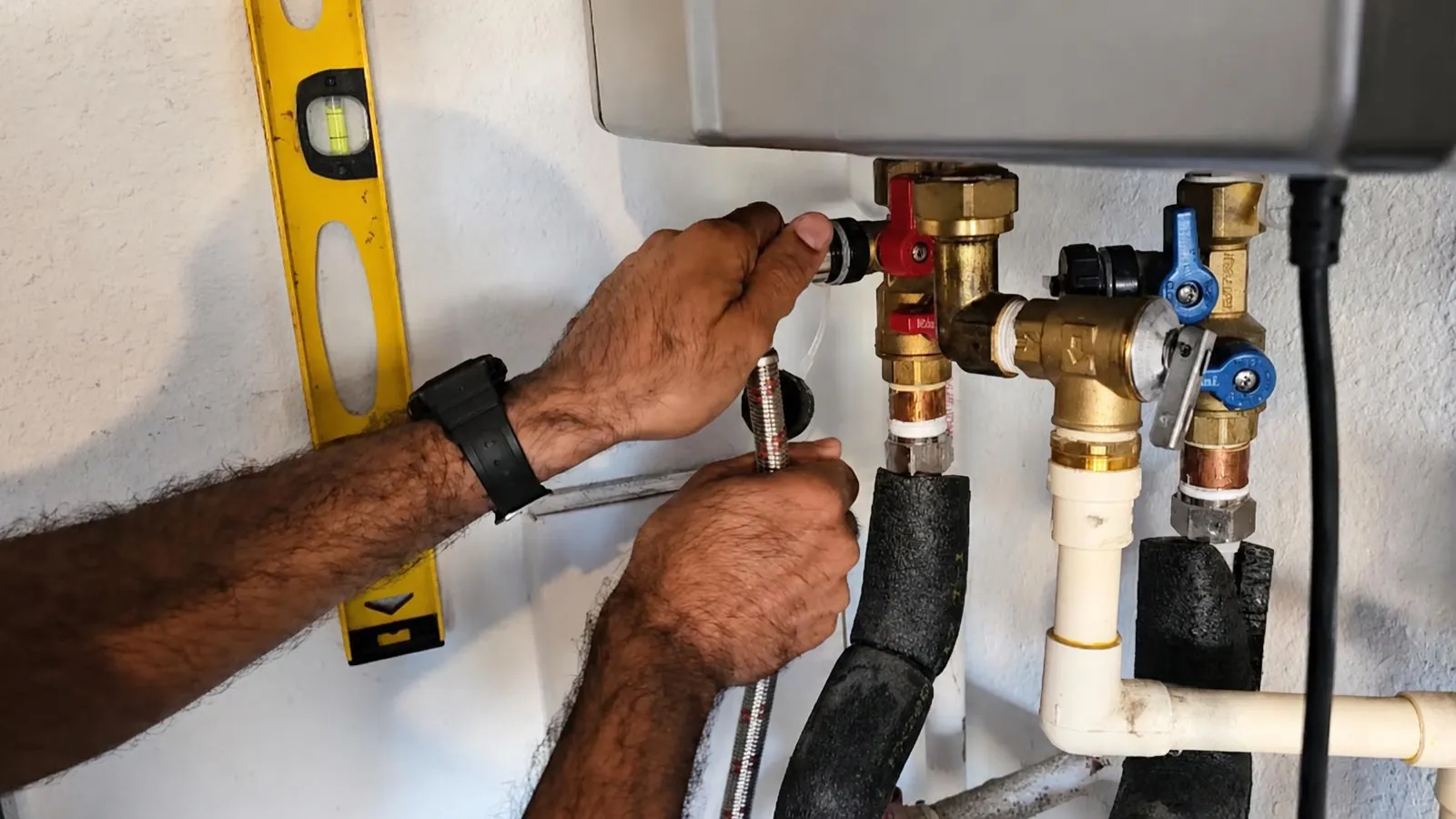
The factors that move the price most
Think of a replacement as a unit plus a set of conditions. Each condition below can add or remove work.
Gas or electric
Gas models need venting and enough gas flow. Electric models need a large dedicated circuit, and some homes cannot supply it without a panel upgrade.
Same location or a move
Putting the new unit where the old one hung is simplest. Moving it means new pipe, vent and wire runs.
Venting changes
A new model may use a different vent material or size. Old flue pipe often cannot be reused.
Gas line upsizing
A tankless unit asks for a large burst of gas at once. If the existing pipe is too small, it must be enlarged.
Water quality
Hard water scale clogs the heat exchanger, so a softener or filter may be advised alongside the unit.
Permits and haul-away
Permit fees, inspections and removal of the old unit show up as separate lines.
Why tankless is rarely a straight swap
A tank sits on the floor and connects with a few fittings. A tankless unit mounts on a wall and carries a much heavier gas or power demand. That is why a new tankless install in an old tank closet can turn into a small remodel.
If you are replacing an existing tankless, the work is usually simpler. The mounting, vent and utility connections already exist, but they still need to match the new model. Check the old model number and bring it to the first conversation.
What Marana's hardness table means for a tankless unit
The Town of Marana's May 2026 table shows hardness of roughly 3 to 14 grains per gallon depending on the neighborhood. Gladden Farms averages about 9 grains, Picture Rocks and the Airline/Lambert area about 12, and the Marana Regional Airport system about 14. The higher the number, the faster scale coats a heat exchanger, so a descaling schedule matters more at the hard end.
Hartman Vistas and nearby neighborhoods average about 5 grains, which is much softer. Even there, scale builds over time, but flushing can be spaced further apart. Confirm your system on your bill before you decide.
The Town states that hardness poses no health risk. It does leave deposits on fixtures, which is why a tankless unit with isolation valves, a flush schedule and possibly a softener is a sensible package. If you live in Picture Rocks, our Picture Rocks plumbing page explains how that area's water and permits differ.
Tank versus tankless: the cost picture over time
Cost is not just the first invoice. Running cost, maintenance and lifespan all count.
| Factor | Tank | Tankless |
|---|---|---|
| Install complexity | Lower, common fittings | Higher, vent, gas or electric upgrades |
| Hot water supply | Limited by tank volume | Continuous, limited by flow rate |
| Space | Floor space, often in a garage | Wall mounted, saves floor space |
| Hard water impact | Sediment builds in the tank | Scale builds in the heat exchanger |
| Maintenance | Periodic flush, anode check | Regular descaling flush |
| Failure mode | Tank leaks, whole unit replaced | Parts can be serviced, exchanger can fail |
| Best fit | Smaller budget up front, simple setup | Space-limited homes, steady demand |
Ask each installer to state the expected maintenance in writing. A unit that needs a yearly flush costs more to own than one that gets ignored, but the ignored one often dies sooner.
How to compare written quotes line by line
Ask for each quote in writing, then lay them side by side. Missing lines are the usual reason one quote looks cheaper.
- Exact make and model, with the fuel type and rated capacity.
- Whether the vent is new, reused or modified, and what material is used.
- Whether the gas line or electric circuit is being upsized, and by how much.
- Isolation or service valves included for future flushing.
- Condensate drain and neutralizer for models that need one.
- Permit application, inspection and who handles each step.
- Removal and disposal of the old unit.
- Wall repair, painting or patching after the work.
- What the manufacturer's paperwork covers and how to register the unit.
- Total price before work starts, with any conditions that could change it.
What to gather before you ask for quotes
A little preparation lets a plumber give you a tighter, more accurate number.
- 1
Photograph the current setup
Take clear pictures of the unit, the label, the vent, the gas meter or electric panel, and the shutoff valves.
- 2
Note your fuel type
Say whether the house runs on natural gas or electricity only, and confirm gas service if you are unsure.
- 3
Record hot water habits
Write down how many bathrooms, showers and appliances run at the same time. Flow demand decides the unit size.
- 4
Know your water provider
Check your bill so you can say which water system serves the address.
- 5
Ask about permits
Contact the Town or Pima County, depending on your address, and ask how water heater work is handled.
Hard water, flushing and long term upkeep
Hard water leaves mineral scale inside a tankless heat exchanger, which cuts flow and efficiency. That is why the service valves and a regular descaling flush matter so much. Our tankless water heater page explains flush service in more detail.
A softener or conditioner may be worth pricing alongside the heater. Our water softener and filtration page covers the options. The Town of Marana advises checking which unit a softener uses, ppm or grains per gallon, before you compare models.
When to call a plumber and what to expect
Some signs point to a repair, others to replacement. A written diagnosis helps you decide.
| Symptom | Possible cause | Likely path |
|---|---|---|
| Error code on the display | Sensor, ignition or scale | Service visit first |
| Water turns lukewarm | Scaled heat exchanger or low flow | Flush and test |
| Water leaking from the unit | Failed exchanger or fitting | Repair or replacement |
| Unit short cycles | Flow too low or vent trouble | Diagnosis visit |
| Unit is far past its expected life | Multiple failing parts | Compare repair against replacement |
Replacing versus repairing
If the unit is young and the fault is a part, repair usually makes sense. If the heat exchanger has failed or the unit has needed repeated service, replacement is more likely. Our water heater replacement page covers how to weigh the choice.
Whichever you pick, ask for the diagnosis and the scope in writing. That is the only way to compare offers fairly. Since the Town of Marana adopted the 2024 International Plumbing Code (IPC) and the International Fuel Gas Code with local amendments, your quote should list permit and venting work as separate lines.
Frequently asked questions
The scope is often different. One may include vent changes, gas line work, permits and haul-away, while the other leaves them out. Compare the written line items before the totals.
Often yes, if the existing pipe was sized for a tank. Tankless units draw a lot of gas at once, so the plumber should check the pipe size against the whole home's gas load.
Only if it has enough spare capacity for a large dedicated circuit. Many homes need a panel review, and some need an upgrade, which may require a licensed electrician.
It depends on your neighborhood's hardness and your usage. Harder areas such as Picture Rocks and the airport system call for more frequent flushes than softer areas. Follow the manufacturer's guidance and your plumber's advice.
Marana lists water heater replacement under its permit application process with a safety inspection, and Pima County requires permits for water heaters in unincorporated areas. Confirm with the right office for your address.
The Town publishes a hardness table by water system. Your own provider may differ by address, so check your bill or ask Marana Water at (520) 382-2570.
Comparing tankless quotes?
Call (855) 575-2890 and we will walk through the scope with you.
Call (855) 575-2890