
Find your number in four moves
You can do this with a water bill and a calculator. No test kit is needed to start.
- 1
Confirm who supplies your water
The Town says several different water providers operate inside its limits. Look at the name and system on your water bill, or use the Town's service-area lookup. If you are unsure, call Marana Water at (520) 382-2570, open 8 AM to 4 PM.
- 2
Match your area to a system row
The table groups neighborhoods by system, such as Gladden Farms under the Marana Municipal system or Saguaro Bloom under Airline/Lambert. The next section lists the rows so you can see where you sit.
- 3
Read both columns
Each row gives a ppm range and an average, plus the same figures in GPG. Use the average for sizing and the top of the range as a sanity check for your worst days.
- 4
Check the unit on any product
The Town's own FAQ tells owners to check which unit a softener uses, ppm or GPG. A box that wants a number in GPG will give a wrong setting if you enter ppm.
The Town table, system by system
These figures come from the Town of Marana Water Department table dated May 2026. Hardness varies by well and season, so treat them as the published range.
| System and areas | Hardness (ppm) | Grains per gallon |
|---|---|---|
| 10-150 Marana Municipal: Gladden Farms, Rancho Marana, Honea Heights, Yoem Pueblo, Marana Main Street, Tangerine corridor | 110 to 200, average 145 | 6 to 12, average 9 |
| 10-150 San Lucas, Warfield Circle, Amole Circle | 110 | 6 |
| 10-092 Picture Rocks, also Continental Reserve and Cortaro and Silverbell areas | 210 to 220, average 215 | 12 |
| 10-138 Airline/Lambert: Avra Valley Rd, Airline Rd, Lambert Ln, Saguaro Bloom, Silverbell Rd and Linda Vista | 210 to 220, average 215 | 12 |
| 10-136 Palo Verde: Twin Peaks and Clayton | 220 | 12 |
| 10-329 Hartman Vistas, Hartman 10, Oasis Hills, Oshrin Park, Cortaro Crossings, Shady Grove, Red Rock Village, Willow Ridge, Twin Peaks and I-10 | 56 to 100, average 76 | 3 to 6, average 5 |
| 10-406 Marana Regional Airport | 230 to 260, average 245 | 13 to 15, average 14 |
Dove Mountain does not appear in the Town table, so we cannot give you a figure for it. Owners there should ask their own water provider for current hardness before sizing anything.
What the Town of Marana table means for your address
Marana Water draws groundwater from the Lower Santa Cruz portion of the Tucson Basin Aquifer, and several separate systems feed different neighborhoods. That is why one household reads 9 GPG and another reads 14. Always size to your own system's row.
Gladden Farms sits on the Marana Municipal system at 110 to 200 ppm, about 9 GPG on average. Saguaro Bloom is on the Airline/Lambert system at about 12 GPG, and the Hartman Vistas area is on a softer system at about 5 GPG. If you moved between those areas, do not carry your old softener settings with you.
The Town says hardness poses no health risk. That makes a softener a comfort and equipment decision, so take your time comparing options.
Converting ppm to grains per gallon
One grain per gallon equals about 17.1 ppm. To convert, divide the ppm figure by 17.1. A reading of 145 ppm works out to about 8.5 GPG, which the Town rounds to 9 for the Marana Municipal average.
Going the other way, multiply GPG by 17.1. A spec sheet that handles 10 GPG is describing roughly 171 ppm. Mixing the two units is an easy error, and it can leave a household badly over or under treated.
What hard water does around the house
The Town states that hardness poses no health risk. Its wording is that Arizona water passes through soils rich in calcium and magnesium and leaves deposits on bath fixtures, dishes and glassware. We do not diagnose health effects of water, so the effects below are about equipment and surfaces.
Water heaters
Minerals settle on the tank bottom and on heating surfaces. That can mean popping noises, slower recovery and a shorter life, so hard areas are where water heater repair calls about scale are most likely.
Fixtures and showerheads
White crust builds on faucet aerators and spray holes, and flow slows as the openings narrow. Vinegar soaks help for a while, but the deposit returns faster at 12 GPG than at 5 GPG.
Dishwashers and washers
Spotty glassware and a film inside the dishwasher are the visible signs. Scale also coats heating parts and inlet screens, where you cannot see it.
Skin, hair and laundry
Many households notice a dry feel after showers and stiff towels. That is a comfort and cleaning issue, not a safety one.
How softener sizing really works
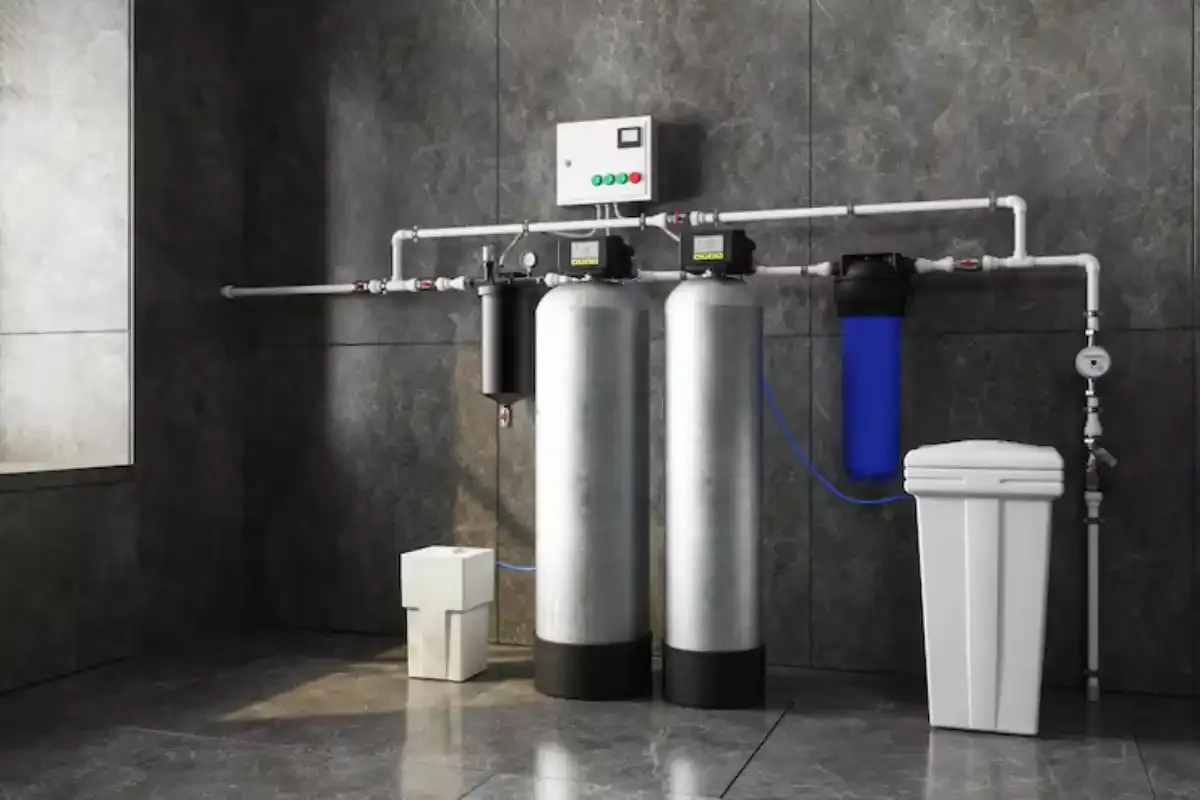
A softener holds a limited amount of hardness before it must regenerate. Its capacity is rated in grains. To size one, multiply the people in your home by the gallons each uses daily, then multiply by your GPG.
A common planning figure is 60 to 80 gallons per person per day. As an example only, four people at 70 gallons each use 280 gallons. At 12 GPG that is 3,360 grains a day, or about 23,500 a week.
Pick a unit whose capacity covers several days between regenerations. A plumber should use your system's number, your headcount and your flow rate, and should show how they got the answer.
Salt-based softener or salt-free conditioner
These two products solve different problems, and sellers sometimes blur the line.
Salt-based softener (ion exchange)
- Removes calcium and magnesium from the water
- Gives the slick feel and spot-free glass most people expect
- Needs salt refills and drains brine during regeneration
- Adds a small amount of sodium to the water
- Best fit for the 210 to 260 ppm systems
Salt-free conditioner
- Leaves the minerals in the water and changes how scale forms
- May reduce crusty buildup but will not make water feel soft
- No salt, no brine drain, less upkeep
- Results vary and are hard to measure at home
Questions to ask before you buy
Use this list with any seller, including us.
- Which GPG number did you use for my system, and where did it come from?
- What is the rated capacity, and how many days between regenerations at my household size?
- Where will the brine drain go, and does it meet local code?
- Is the contractor's Arizona Registrar of Contractors license class correct for water conditioning work, and can I check it at roc.az.gov?
- What upkeep does the unit need, and what does a salt refill involve?
Which direction fits which system
This is a starting point, not a sale. Your household size and goals change the answer.
| Your system's GPG | What you will likely notice | Reasonable next step |
|---|---|---|
| 3 to 6 (10-329 areas) | Some spotting, light scale | Descaling habits may be enough, a softener is optional |
| 6 to 12 (10-150 areas) | Visible scale on fixtures and glass | Softener worth pricing, size to about 9 GPG average |
| 12 (10-092, 10-138, 10-136) | Heavy scale on heaters and spray holes | Salt-based softener is the usual choice |
| 13 to 15 (airport system) | The hardest in the Town table | Size generously and plan regular heater flushing |
When to call a plumber
Call if you need a softener plumbed in, a bypass added or a drain run, since the work touches your main water line and the drain. Call too if the heater makes new popping noises, a fixture loses flow with no visible crust, or a softener that worked before suddenly stops.
If you own a unit and the water is hard again, check the salt level and the bypass position first. After that, stop and call, because the fault may be the control valve or the resin. Owners in Picture Rocks should also confirm their provider on the water bill, since not every property there is on the Town system.
Because a softener connects to supply and drain lines, its installation falls under the 2024 International Plumbing Code (IPC) the Town of Marana has adopted, so ask the installer about permit steps before you buy.
Frequently asked questions
No. The Town publishes a separate figure for each water system, and they range from roughly 3 to 14 grains per gallon depending on the neighborhood. Look up your own address before you size anything.
Divide ppm by about 17.1. For example, 215 ppm is about 12.6 GPG, and the Town lists that system at 12 GPG. Many softener controls ask for GPG, so confirm the unit on the screen.
The Town says hardness poses no health risk. We do not diagnose health effects of water, so for questions about contaminants read your system's annual Consumer Confidence Report or call the Town's water quality line at (520) 382-2523.
You can, but expect different results. A conditioner leaves the hardness minerals in the water, so it will not feel soft and some scale may still form. For spot-free glass, a salt-based unit is the better match.
Different streets near a system boundary can be served by different wells or systems. For example, the Town table lists Continental Reserve under the Picture Rocks system, not the Marana Municipal one. Check your bill for the provider and system.
Softened water reduces mineral buildup inside a tank and on its parts, so it usually helps. It does not replace maintenance, so ask about draining and anode checks for your tank type.
Still deciding? Call the 24/7 line.
A person answers, listens to the problem, and tells you what happens next.
Call (855) 575-2890